{{ digitsEl }}...
In a slightly different reality…
Sinclair ZX Spectrum
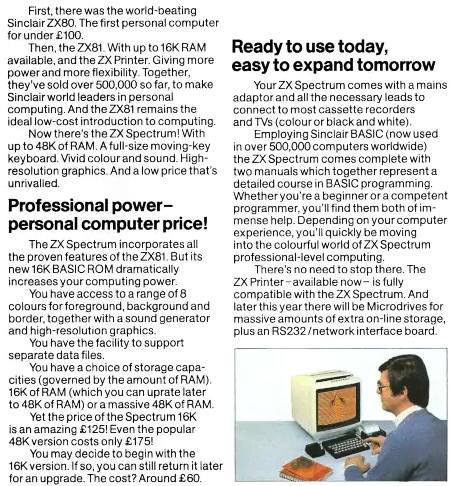
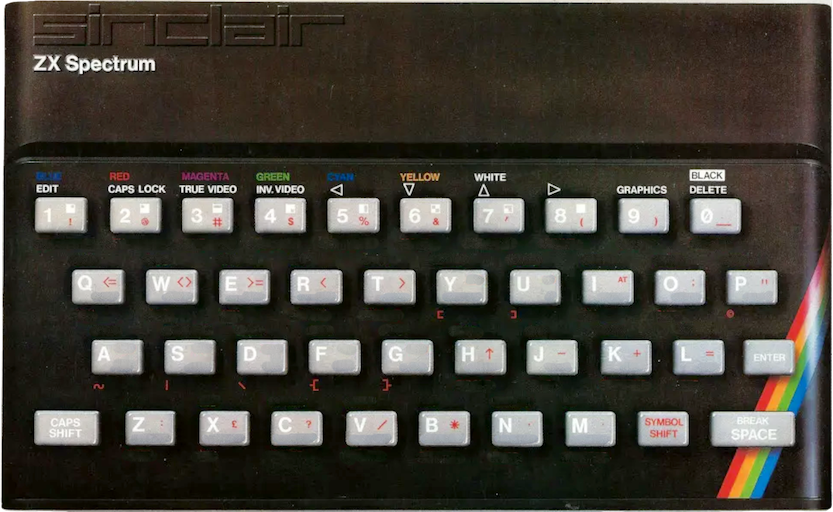
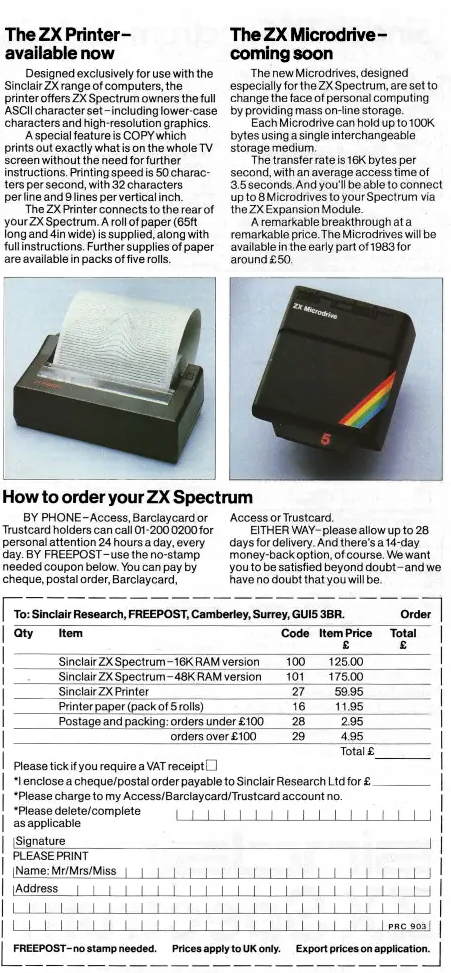
This is the astonishing new ZX Spectrum — a powerful professional’s computer in everything but price!
There are two versions — 16K or a really powerful 48K. Both have a full 16 colours, sound generation, a full-size moving-key keyboard and high-resolution graphics. Plus structured programming, syntax colouring and report codes!
“The world’s best personal computer for under £500.”
We’ve time-travelled back to the 1980s and changed the past…
A home computer classic modified with the power of Retrofabulation™
The same hardware constraints, turbocharged with today’s software knowledge. Could it have been faster, funner, better, knowing what we know now?
Yes.
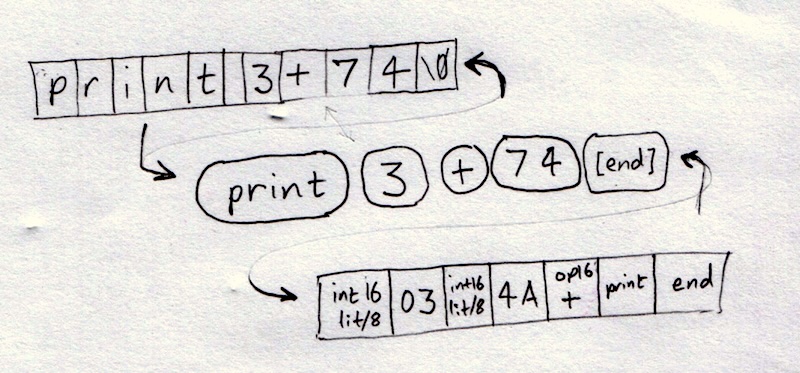
The user’s program is held as text while they type; as compact tokens for listing; and as fast, VM bytecode at runtime, converting back whenever needed. That gives us readable listings and extremely fast execution speed, without wasting memory.
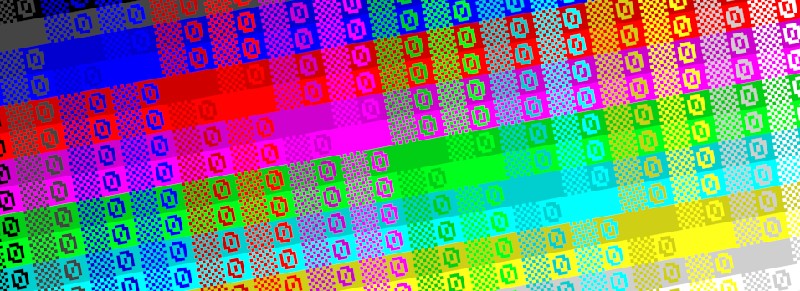
The original Spectrum spent one attribute bit per screen block on a rarely-used FLASH code. If we reclaim that bit as a second brightness bit, a cell's two colours can each be bright or normal, for a full 16-colour palette, two colours per cell, and occupying the same amount of screen memory.
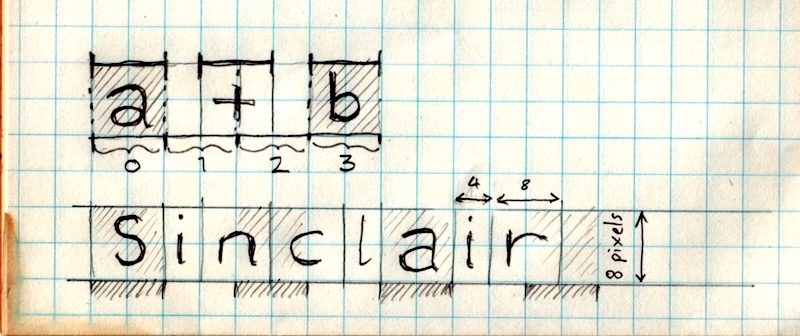
Characters are spaced semi-proportionally on a 4×8 pixel-grid, so text reads more easily. The space character is 4 pixels wide, so it kicks the next word into the next colour cell: individual words can be coloured differently without colour-clash.
Forty years of code from enthusiasts and volunteers: Let’s bring it back to the 80s for everyone to enjoy.
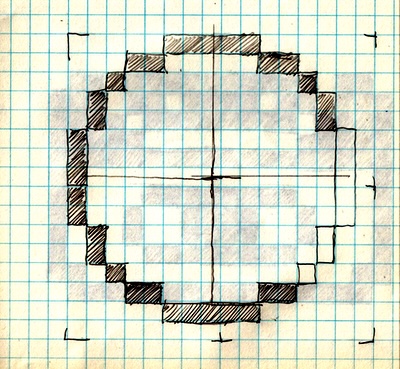
Bresenham's line and circle routines run 50× faster than Sinclair's originals.
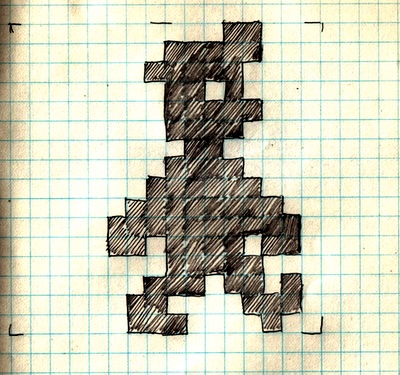
Built-in sprite and scrolling primitives elevate what a beginner can achieve in a few lines of code.
Modern turbo-loaders can reliably LOAD and SAVE up to 20% faster than the original ROM.
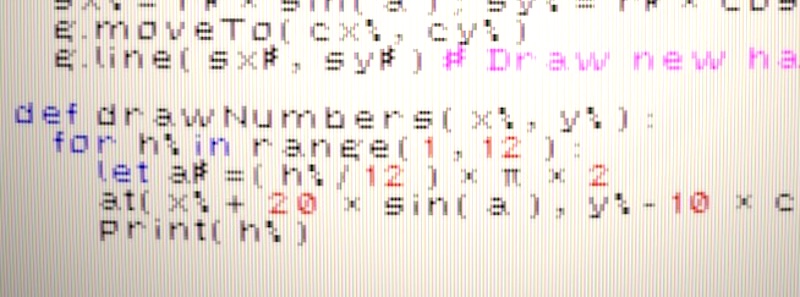
Structured code can run faster than GOTO-based BASIC — as BBC BASIC proved — and it's easier to learn, and it instills good habits from the start.
More detail in next section.
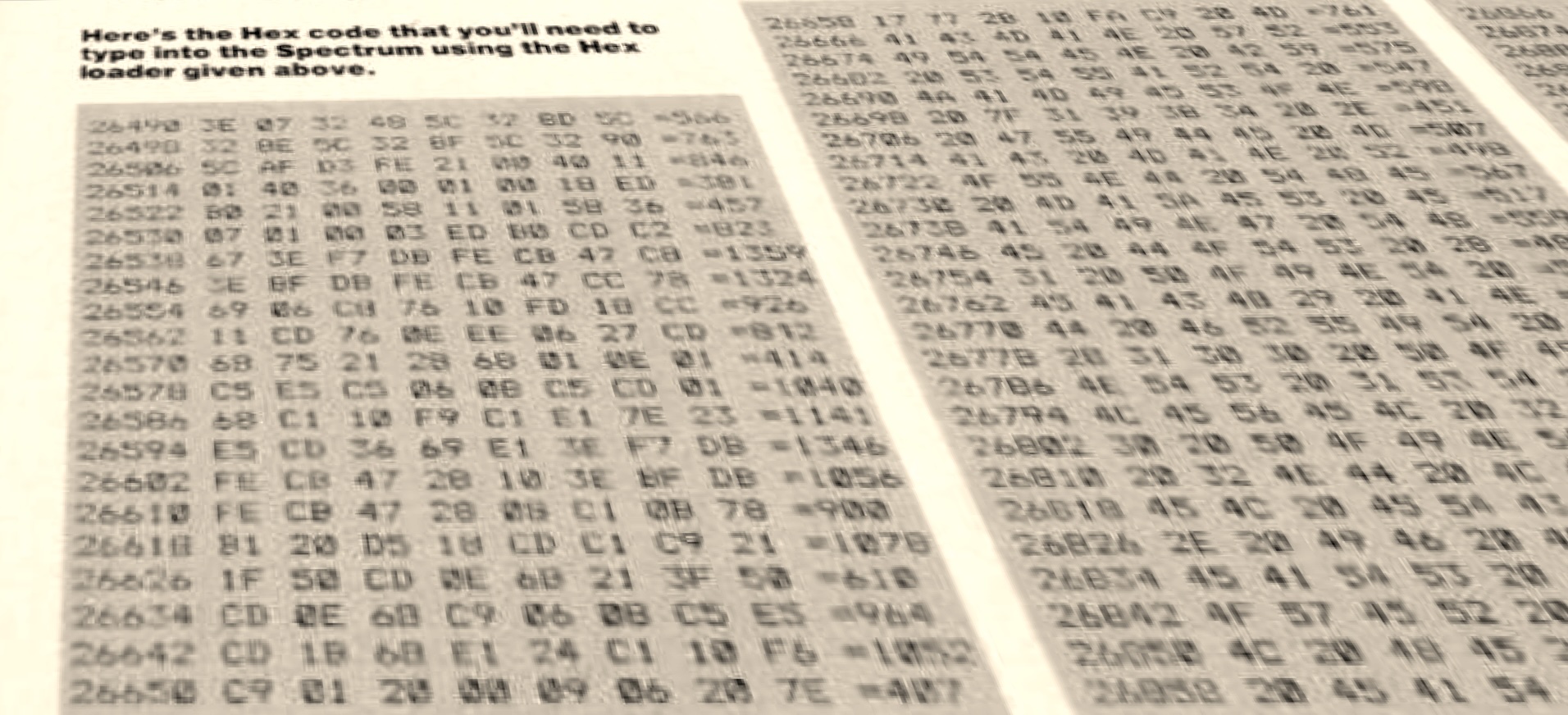
Typing hex listings from magazines was the bane of every micro-user's life. A built-in mode for entering machine code, with user-friendly error detection and correction: it could have saved tens of thousands of child-typing-hours across the world!
A modern, structured programming language, targetted at a micro with limited RAM. Organisational structures include functions/procedures and modules.
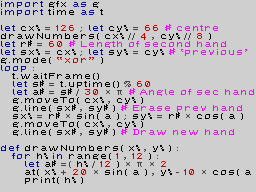
import gfx as g
import time as t

let cx% = 126; let cy% = 66 # centre
drawNumbers( cx% // 4, cy% // 8 )
let r# = 60 # Length of second hand
let sx% = cx%; let sy% = cy% # ‘previous’
g.mode( "xor" )
loop:
 t.waitFrame()
 let s# = t.uptime() % 60.0
 let a# = s# / 30 × π # Angle of sec hand
 g.moveTo( cx%, cy% )
 g.line( sx#, sy# ) # Erase previous
 sx% = r# × sin(a); sy% = r# × cos(a)
 g.moveTo( cx%, cy% )
 g.line(sx#, sy#) # Draw new one

def drawNumbers( x%, y% ):
 for h% in range( 1, 12 ):
  let a# = ( h% / 12 ) × π × 2
  at( x% + 20 × sin( a ), y% - 10 × cos( a ) )
  print( h% )
1 2 3 4
Modules can be built-in (ROM), loaded from tape, or defined as part of the program. They help organise the code, and keep code navigation fast.
Modules promote extensibility too: type in a module from a computer magazine, and easily use that feature in your programs.
Syntax colouring, proportional font, and automatic block indentation.
Code is as readable as it could be on a 1980s TV screen.
A block-structured language, in the style of 1991’s Python.
Control flow is explicit and clear, which is great for beginners. The unambiguous structure also helps it be very fast to execute.
A compromise between performance and compactness-of-code, identifiers can include BASIC-style sigils to indicate the type of the value: $ for strings; % for integers; # for real numbers.
 1
2
3
1
2
3
![[Font sample showing two lines of nonsense text.]](./font-sample-2-lines.png)
The character set includes support for most European languages, plus common typographical and mathematical symbols.
It’s ASCII-compatible (of course), and includes almost the whole repertoires of the Amiga’s Latin-1 (1985), Mac Roman (1984) and Windows Codepage 1252 (1987).
This means that as well as © (copyright symbol), there’s ™ and ®; punctuation like proper ‘quote marks’ French «guillemots» and bullets •. Maths, including ≠ (not-equal) and π (tasty). And letters for writing Scandinavian languages, like þÞ and Ðð.
Many 1980s computers represented accented characters — like the é in café, or ü in Mötley Crüe — as individual, whole characters, but this takes up a lot of space in ROM; there are dozens of common combinations, especially when you add capitals and lower-case: É é ä ö ï ü à À…
We encode diacritical marks as separate code-points, so they can be composed with almost any other letter. This reduces the size of the font in ROM, and increases its expressability.
IN PROGRESS
Back to the . . . Present
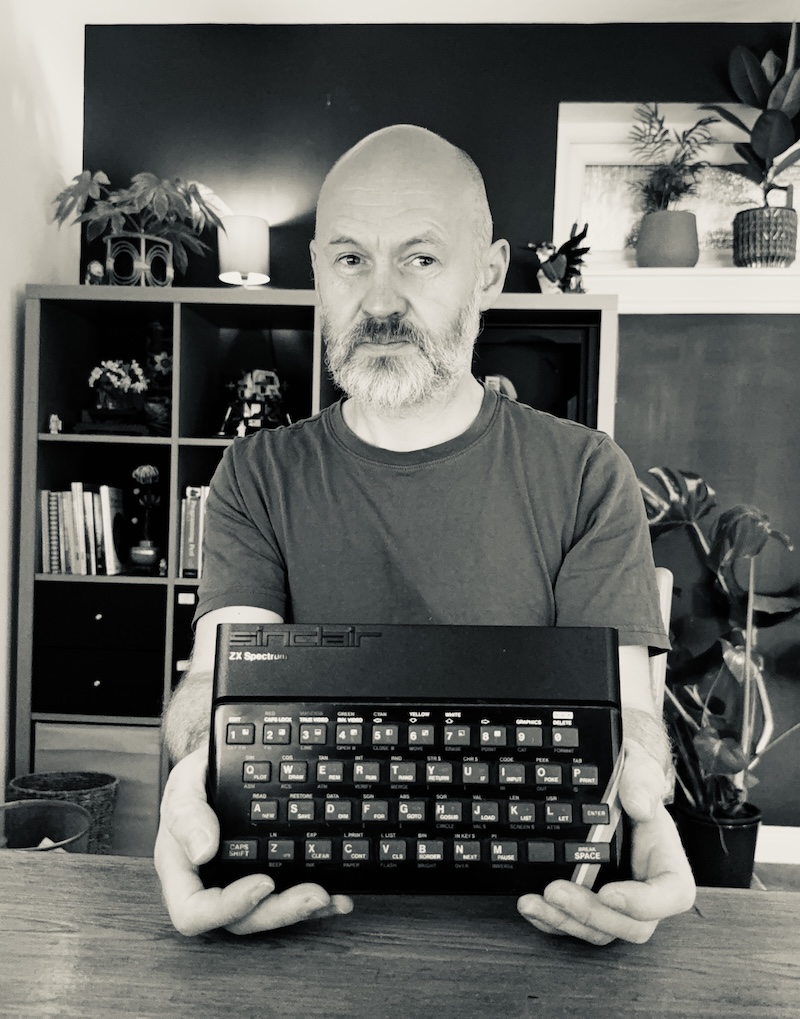
I woke up one morning in February 2024 with the idea almost fully-formed: a grand, spurious ‘what if’ reimagining of the ZX Spectrum’s system software.
I had specific ideas about enabling a little, beginner-freindly language to run really fast on the Z80. I was sure we could (re)make the rest of it qualitively, and palpably ‘better’ too.
Why? Because it’s there.
It’s become a bit of an personal obsession; an itch I’ve enjoyed scratching. We seem to be amidst a retro-computing revival, so perhaps you’ll enjoy seeing where this goes too.
Andrew Forrest is a professional software engineer based in Glasgow. He got his Computer Science degree from the University of Strathclyde in 1995 and in the decades since, he has developed systems for recycling companies, well-known Scottish food companies, the power-generation industry, and the Scottish government. He’s always enjoyed a bit of digital archeology too: pulling apart ancient legacy systems and making them work better.
He learned to program on the family ZX81, then later on ZX Spectrum and Commodore Amiga. These days he uses a Mac. Sometimes he performs in plays and musicals.
If you have a problem, if noone else can help, and if you can find him on LinkedIn, maybe you can hire, the A.
We're working toward a Kickstarter campaign to fund the final stages of development. Leave your email and we'll send you one message when it launches — plus some very occasional update messages.
No spam or ads. One message when the Kickstarter launches, plus irregular updates. Unsubscribe whenever you want.